
At first, it looked like Turkey might be spared. In the initial days of the Iran war, nearly every other country in the region was targeted by missiles or drones, while Turkey remained unscathed. Many experts judged the Nato member “too risky” a target, and figured Iran wouldn’t dare.
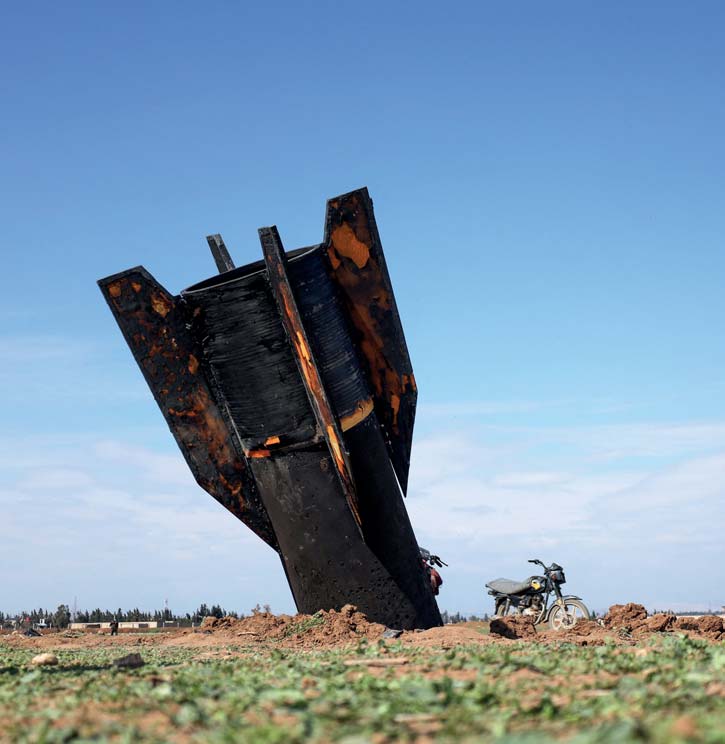
But on the afternoon of 4 March, the unexpected occurred: Nato intercepted what it said was an Iranian ballistic missile headed for Turkish airspace; debris from the munition fell in Hatay Province, near the border with Syria. A second missile was neutralised over the southern Turkish province of Gaziantep four days later, its debris littering an open field. Early on 13 March, Turkish media reported that a third missile had been intercepted in Turkish airspace over the south-eastern city of Adana, closer than ever to its likely target. Adana is home to Incirlik Airbase, a Turkish facility with a significant US troop presence. Incirlik also provides storage for between 20 and 50 US tactical nuclear weapons.
There were no injuries or casualties in any of these cases. But the incidents intensified anxieties around Turkey’s delicate position in the conflict and the region: suspended between warring parties, with a new regional heft that has proved an irritant to Israel’s hegemonic aspirations. As characterised by the foreign policy analysts at the Istanbul-based think tank IstanPol, Turkey is operating “from the margins of overlapping regional and international orders”.
After news of the first missile broke, the immediate concern for many was Article 5 – the section of the North Atlantic Treaty in which Nato’s foundational principle of collective defence is embedded. It states that an attack on one member state is an attack on them all: allies are obliged to come to each other’s defence. Article 5 has only been triggered once in Nato history – by the US after the terrorist attacks of 11 September 2001.

After the first missile was intercepted on 4 March, Nato’s secretary general, Mark Rutte, appeared in the media insisting that the incident would not trigger Article 5. Rutte also emphasised that the circumstances under which collective defence would be invoked are deliberately opaque, a policy necessary to keep the enemy in the dark. “For good reason, we will always remain very ambiguous about when Article 5 is triggered,” he said. Iran, for its part, has denied ever firing missiles at Turkey, and has vowed to form an investigative body to ascertain who did.
Indeed, Turkey-bound Iranian missiles were a surprise. Turkey’s relations with Iran are cordial, if competitive. Giorgio Cafiero, CEO of Gulf State Analytics, tells me the relationship is one of “cooperative rivalry”. Turkish officials have repeatedly emphasised their desire not to be drawn into a regional war. Before 28 February, Turkey was engaged in diplomatic efforts to reduce tensions between Washington and Tehran. A few weeks ago, Ankara estimated that Iran’s reach across the region had been diminished. Prior to 7 October, Ankara viewed Iran as unpredictable: a destabilising force in the region, and one with which it was often at odds in places like Syria. There, Iran had backed Bashar al-Assad in the country’s civil war and Turkey had backed the Islamist rebels that ultimately toppled him.
But thanks to the wars unleashed since 7 October, Turkey had believed Iran’s capacity to export violence been reduced: Assad has been overthrown, and Israel had supposedly degraded Iran’s regional networks, including Hezbollah. That calculus is now undergoing rapid revision.
The missile incidents have produced new anxieties, not least over the question of what would happen if Israel attacked Turkey instead of Iran. In mid-February, the former Israeli prime minister Naftali Bennett told an audience, “Turkey is the next Iran.” It was the latest in a series of inflammatory statements by Israeli public figures about the supposed Turkish threat. In September, the former Israeli defence minister Benny Gantz said, “Turkey’s goal is to build octopus-like arms, as Iran has done.” That same month, at a ceremony marking the opening of the Pilgrimage Road in Jerusalem, Benjamin Netanyahu addressed Turkey’s president, Recep Tayyip Erdoğan, directly. “This is our city, Mr Erdoğan,” he said. And after Qatar was targeted by Israel last year, Israeli academic and writer Meir Masri wrote: “Today Qatar, tomorrow Turkey.”
Part of this can be attributed to the shifting post-7 October regional order, a process accelerated by the fall of Assad. With a pro-Ankara government now in power in Damascus, Turkey’s reach extends further into neighbouring Syria. Meanwhile, Israel continues to occupy Syria’s Golan Heights, and has attempted to sow ethnic discord by fashioning itself as the defender of minorities against the central government. Israel is exploiting real fears – both the Druze and Alawites have been subjected to mass ethnic violence since Syria’s new government came to power – in pursuit of fragmentation and decentralisation for its own benefit. A disintegrating Syria would pose little threat to Israel, whereas a strong, unified Syria eventually might. It is the same policy of stoking chaos and “balkanisation” that some believe Israel now seeks in Iran.
Another potential front for Israeli-Turkish tension is the eastern Mediterranean. “There is indeed a growing rapprochement between Greece and Israel, motivated by their mutual aversion to Turkey,” Sinan Ülgen, a former Turkish diplomat, tells me. “This type of alliance can be a security risk for the region since Turkey would be motivated by engineering its own alliance of Arab states that are concerned by Israel’s aggressive regional politics and the dwindling credibility of US security guarantees.”
Indeed, just a few days before launching the war on Iran, Netanyahu announced a new “hexagonal” approach to the region, focused in part on countering Turkey, resting heavily on Graeco-Israeli alignment. “In the vision I see before me, we will create an entire system, essentially a ‘hexagon’ of alliances around or within the Middle East. This includes India, Arab nations, African nations, Mediterranean nations (Greece and Cyprus), and nations in Asia that I won’t detail at the moment,” he said.
On 9 March, the Turkish ministry of defence announced it was deploying six F-16 fighter jets and air defence systems to Northern Cyprus after a drone hit the British Akrotiri airbase in the south of the island.
A Nato member since 1952, Turkey has long exposed the alliance’s contradictions. The 1974 Turkish military operation on Cyprus remains a source of tension between Nato allies Greece and Turkey to this day. A military conflict between Turkey and Israel would pose an even graver existential challenge, and could undermine the principle of Article 5; while Israel is not a member of Nato, both countries are allies of Britain and the US.
In recent years, Turkey has also pursued an autonomous foreign policy, privileging the attainment of regional-power status and relations with countries outside the West, including Russia, over Nato partnerships. This pivot made some sense: Nato has long touted “Western values”, giving the alliance a civilisational identity that potentially excludes Turkey. Indeed, the changing regional order is being felt beyond the Middle East. On 15 March, Donald Trump warned that the trans-Atlantic alliance would face a “very bad future” if allies did not help the US open the Strait of Hormuz.
Some observers warn that Israeli politicians’ provocative statements should be read with caution. “I do think Israeli security and political officials increasingly see Turkey as a strategic rival, above all in Syria,” says Yonatan Touval, a senior policy analyst with Mitvim, an Israeli foreign policy think tank. “But I would not take the ‘next Iran’ line too literally.” Bennett is returning to the political arena with a new right-wing party, and Touval suggests his statement can be seen as a bid to outflank Netanyahu on the right. For Israel, he says, Turkey is not a “new Iran” but a new kind of problem: a major regional actor whose enhanced power in Syria, “posture on Gaza, and ambitions in the eastern Mediterranean increasingly collide with Israeli interests”.
Ülgen concurs. “I don’t take this type of remark too seriously,” he says of Bennett’s February speech. He believes Turkey’s Nato membership and strong military assets would make a direct conflict with Turkey too costly for Israel. But he says this doesn’t rule out proxy conflicts “in other regional theatres like Syria or the eastern Mediterranean”.
Other recent news has created alarm in Turkey. In the war’s first week, reports leaked that the CIA was planning to send armed Kurds into Iran to foment an uprising. Those reports have since been walked back: Kurdish groups have not been particularly eager. If that changes, the Turkish government’s concern is that the US and Israel would arm groups linked to the Kurdistan Workers’ Party (PKK), a militant organisation that has been at war with the Turkish state since 1984. Such a move would also disrupt negotiations between the Turkish government and the imprisoned PKK leader Abdullah Öcalan, aimed at ending the protracted conflict. Last year, Öcalan told the PKK to lay down arms, but the group’s Iranian chapter, the Kurdistan Free Life Party (PJAK), refused. Mustafa Caner, an assistant professor at the Middle East Institute of Sakarya University, says that Turkey is already taking precautions. During last year’s Twelve-Day War, “the Turkish minister of defence stated that there was intelligence sharing between Turkish and Iranian security forces”, he tells me.
However, in crisis there is also opportunity: Erdoğan is adept at transforming regional wars into domestic and diplomatic capital. In addition to Erdoğan’s big win in Syria, Istanbul has hosted peace talks between Russia and Ukraine, allowing Turkey to position itself as peacemaker. The need for beefed-up European defence has also made Turkey appear a more attractive partner for the EU. Projecting power on the world stage has helped offset the pain of eye-watering inflation and years of currency depreciation at home – at least temporarily. If the missiles stop flying, the Iran war might prove similarly convenient. Appropriately, Turkey is hosting this July’s Nato summit, where Ankara will have an opportunity to promote itself as indispensable, but where the alliance’s mounting contradictions will also be impossible to ignore.
[Further reading: The battle for the Strait of Hormuz]
Content from our partners



Related

This article appears in the 25 Mar 2026 issue of the New Statesman, Easter Special
Join the debate
Subscribe here to comment